
Unbundling Version Two

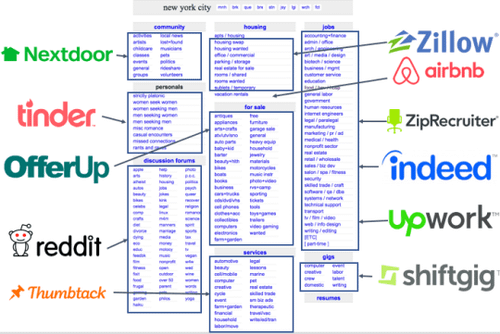
In the first wave of internet startups that were very successful, people called it “The Great Unbundling”. If you look at Craigslist, there were a lot of successful startups that were unbundled from Craigslist. Here is a graphic example.
In an obtuse way, Twitter was unbundled from Facebook. Take the status line from Facebook, and it’s Twitter.
Software as a service (SaaS) is another piece of evidence of the great unbundling. A lot of SaaS companies were created by unbundling. Behemoths were created, like Salesforce. The behemoths started to rebundle.
This tracks with Professor Ron Burt’s studies on human networks as well. When they get unbundled, they get reformulated and rebundled.
Today, artificial intelligence (AI) is leading a new wave of unbundling. It’s disintermediating SaaS companies. Some SaaS companies will survive. Others will not.
For years, software companies tried to pack as many tools as possible into one big product. Think of apps like Microsoft Office, which gives you Word, Excel, PowerPoint, email, and more, all in the same bundle. The idea was simple: if they gave you everything in one place, you would never need to look anywhere else.
But today, something new is happening. Artificial Intelligence (AI) is quietly breaking these bundles apart. Instead of using one giant app for everything, people are turning to smaller AI tools that do a single job extremely well. For example, instead of opening PowerPoint to design slides, someone might ask an AI tool to design a full presentation in seconds. Instead of a complicated video editor, a simple AI tool can turn a script into a video automatically.
Vertical-walled gardens are threatened. Isn’t innovation and competition grand? Consumers and businesses will eventually get more of what they want at a lower price. No need for government regulation or price fixing, subsidies, or market meddling.
However, we are also seeing a great unbundling in hard tech and physical goods. That’s great for consumers too. SpaceX is but one example of that.
Boeing is getting unbundled.
SpaceX, Anduril, Boom, and other companies are unbundling Boeing. Boeing, Lockheed Martin, and the other defense contractors became sclerotic. Their business model was incompatible with innovation and the way software and hard tech worked. Palmer Luckey put it plainly: they do not wait for a bid to build; they build and then see if the Defense Department wants to buy it. That’s a huge difference in culture and framing.
We are seeing that over and over again in physical innovation. Robots in farming and robots in fishing. Robots and AI in medicine. Check this out as one example in medicine. Midjourney started as an AI jokey app. It’s now revolutionizing imaging.
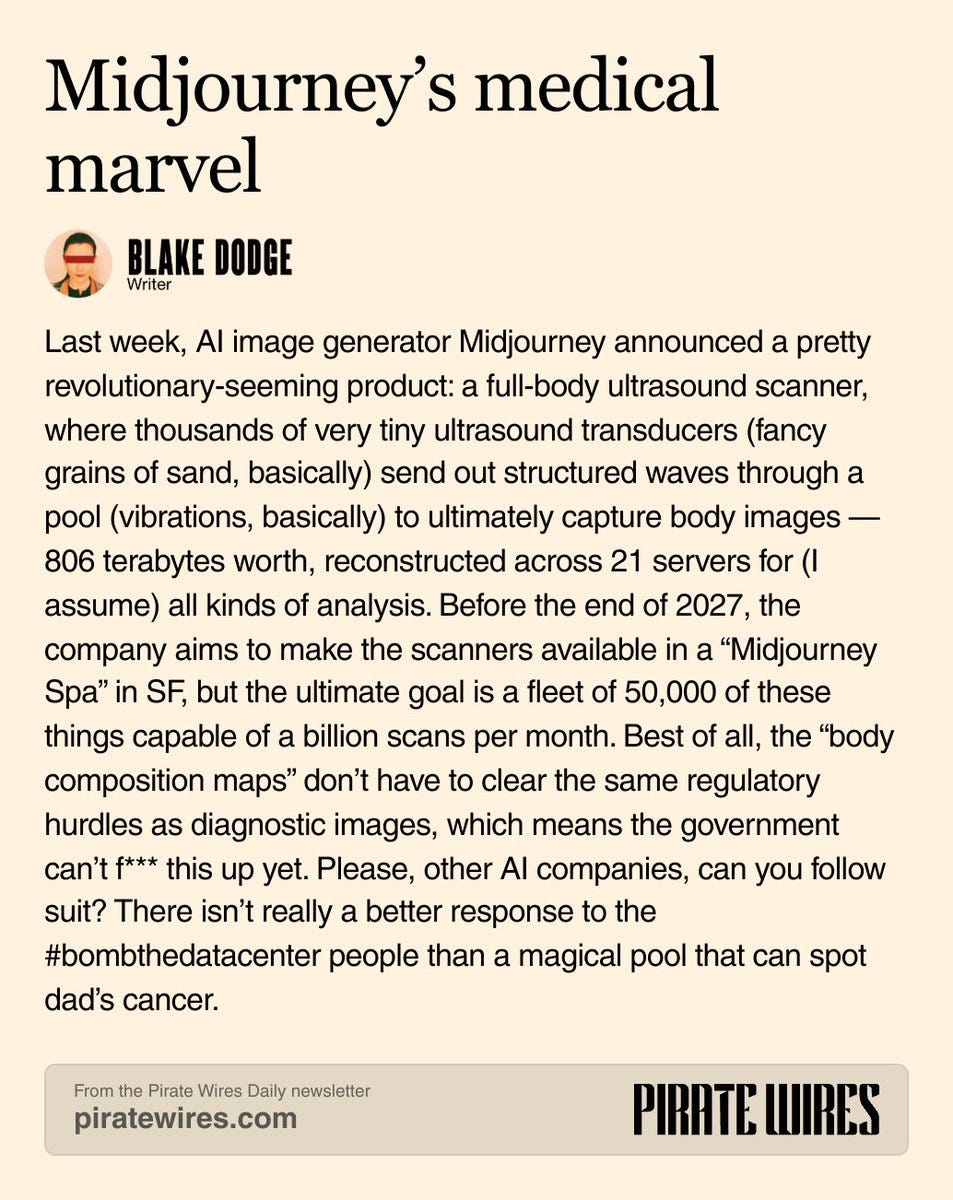
The doomsayers say that this AI innovation and robots will ruin humanity, but doomsayers are always wrong, going back to the flat-earthers in the 15th century.
This is huge for humanity. What enables it?
Freedom for sure. You can’t have people like Bernie Sanders and his group of morons involved. JB Pritzker decided to have a crypto transaction tax in Illinois. He is a moron and anti-innovation.
Low regulation, no tax. Why did the internet boom in the 1990s? No sales taxes online. Look what it brought us.
Cheap, plentiful energy. That means nuclear. It doesn’t mean optionality. It doesn’t mean diversity. It means nuclear. A proven source that works 24/7. Solar is fine in areas where the sun shines, and it's closed-source dedicated usage. Like a house. Wind can’t work. Geothermal works is more expensive and only work in certain places. Nuclear nuclear nuclear.
Material. That means mining. All this tech stuff takes rare earths, crude oil, and things we get out of the ground.
Data Centers. Lots of them. Computing power and storage are the constraints that can hold innovation back. Data Centers do not use a lot of water, nor do they increase power rates. They provide lots of jobs when building them. They provide many jobs while operating them. They create millions of jobs by merely existing.
SpaceX created the first trillionaire in Elon Musk. By the way, he created many prior companies on his way to becoming a trillionaire. The first one he participated in was PayPal. He was a joiner, not a founder. Innovation will create more trillionaires because, as we grow, market sizes get larger.
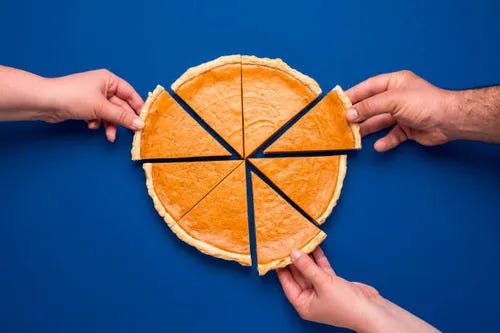
Humanity is not a fixed pie. You can always get more pie. You just have to rethink, reframe, and work for more pie.
The people who look at the world as a fixed pie don’t want to work. They’d rather take from you.
Great post by the way.
As Sowell and others before (and after) have said, "human capital". If you substitute human capital as an image where you have the pumpkin pie it becomes limitless. Free people, free ideas, free speech and free markets.