
What Is Diligence?
The State Infrastructure Bank And The Nevada State Treasurer

When people listen to startup investors talk about how they invest in startups, a lot of times the investor will mention the term “due diligence”. Then, they move on.
When I angel invested, I did rigorous analysis before I’d cut a check. Angel investing is different than fund investing but the basic premise and process is the same. At Hyde Park Angels, we professionalized diligence.
If you are going to be successful investing in startups or companies, you cannot go by gut feel.
What is due diligence? Below is our deal memo from the venture capital fund I co-founded. To give you a sense of our thesis, we invested in business to business finance companies that were revolutionizing the world of finance. We only invested in companies in the US, Canada, Great Britain, and the EU. We would invest $500,000 to $750,000 in the very first round. Two people and an idea generally.
We ran a statistical analysis before we started investing and calculated what our return would have to be so that initial check would pay back the entire fund. That’s minimum of 22x. Currently, our fund is 3x+, with a 22% IRR. Pretty good for a pre-seed venture fund. I just got a report today one of our portfolio company revenues are up 228% year over year. That was a nice surprise.
We would fill out these reports completely in detail for every single pitch we heard. If you went to business school, you might remember SWOT analysis or Porter’s Five Forces. Our diligence encompassed that and more. My partner and I would work on them separately, then together to make sure we covered all the angles.
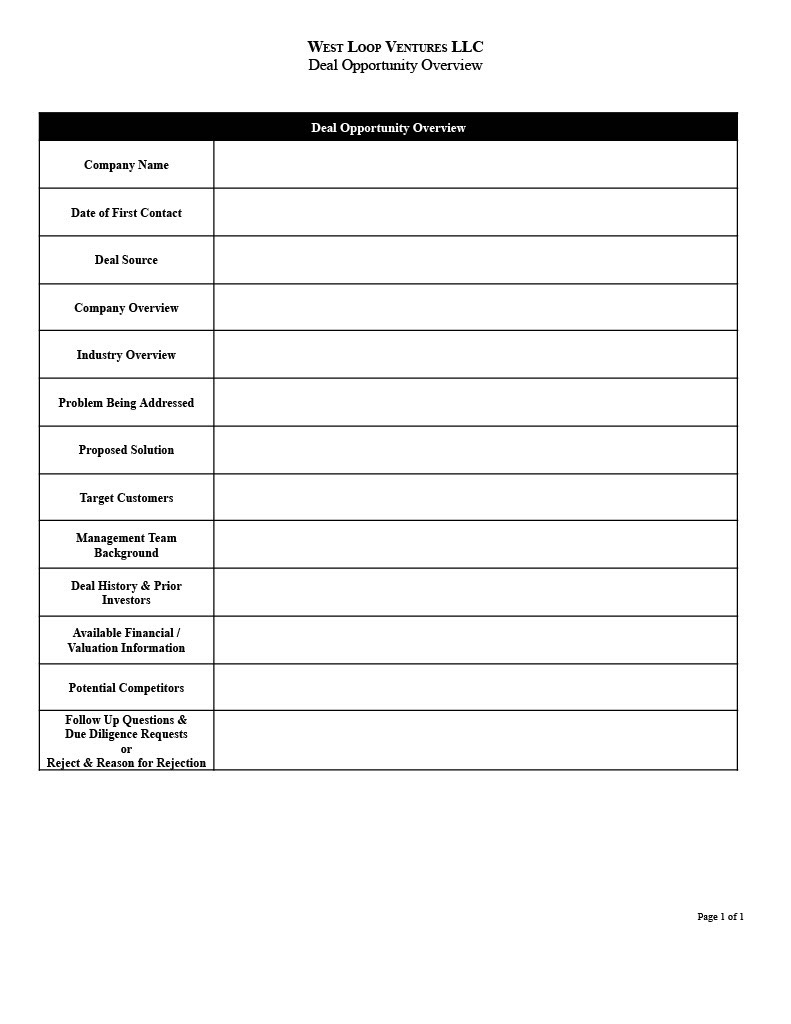
We also would do more than the report. Here are some other things we would put on our checklist. This is not exhaustive and would sometimes change, deal by deal.
Salary and Compensation for all current employees
Bank Statements
Copies of major subscription contracts
Credit and Background checks on founders
Agree on Non-Competes for all employees and founders
Agree on Employment Agreements as needed
Agree on vesting of shares.
Prior term sheets from previous raises (want to make sure there are no “gotchas” that will bite us down the road)
Current Operating agreement
Certificate of Formation, Articles of Incorporation and Operating Agreement for C-Corp
Legal review of all pertinent docs by WLV lawyer
We’d also call existing customers if there were any and extensively interview them about the market. Ironically, we asked very few questions about the company we were thinking about investing in. We assumed since they were a customer, they were addressing a pain point in the business and it was always easy to get them to chat about pain points.
At the end, we wanted to be able to talk about the company we invested in with very deep knowledge. It helped us when we sat on boards and were advisors.
How long did all this take?
If we rejected a company, we were always a very fast “No”. Within two weeks was our internal metric because we respected the entrepreneur. Entrepreneurial businesses when they raise capital are like tomatoes on a vine. There is a point where they will just get overripe, drop and fall to the ground. If we rejected someone, we wanted to give them the chance to raise money somewhere else.
A “Yes”, took longer. Usually a couple of months or so.
What were the biggest drivers of a '“Yes”?
There were two major ones. First, the people. If we thought the entrepreneurial team was great, and could take a company across the finish line we would invest.
Second, it had to be a big market, and the company had to have some sort of protective moat. As a venture investor, you never want to invest in a business that will become commoditized because then it’s just a price war.
The skills that I used to analyze each and every deal in our venture fund are directly applicable to the State Infrastructure Bank. The Nevada State Treasurer chairs that operation. The money that is invested by the SIB is supposed to return back into the SIB so it can be reinvested.
Kind of like a venture capital or private equity fund.
Yes, the projects are not software startups. However, the discipline, risk analysis, understanding how to net present value a project with a defined hurdle rate and basic blocking and tackling financial concepts finance pros put to use every single day are integral to the success of the SIB.
Nevadans deserve that expertise of their state treasurer.
Excellent.
Are you channeling Warren Buffet?